
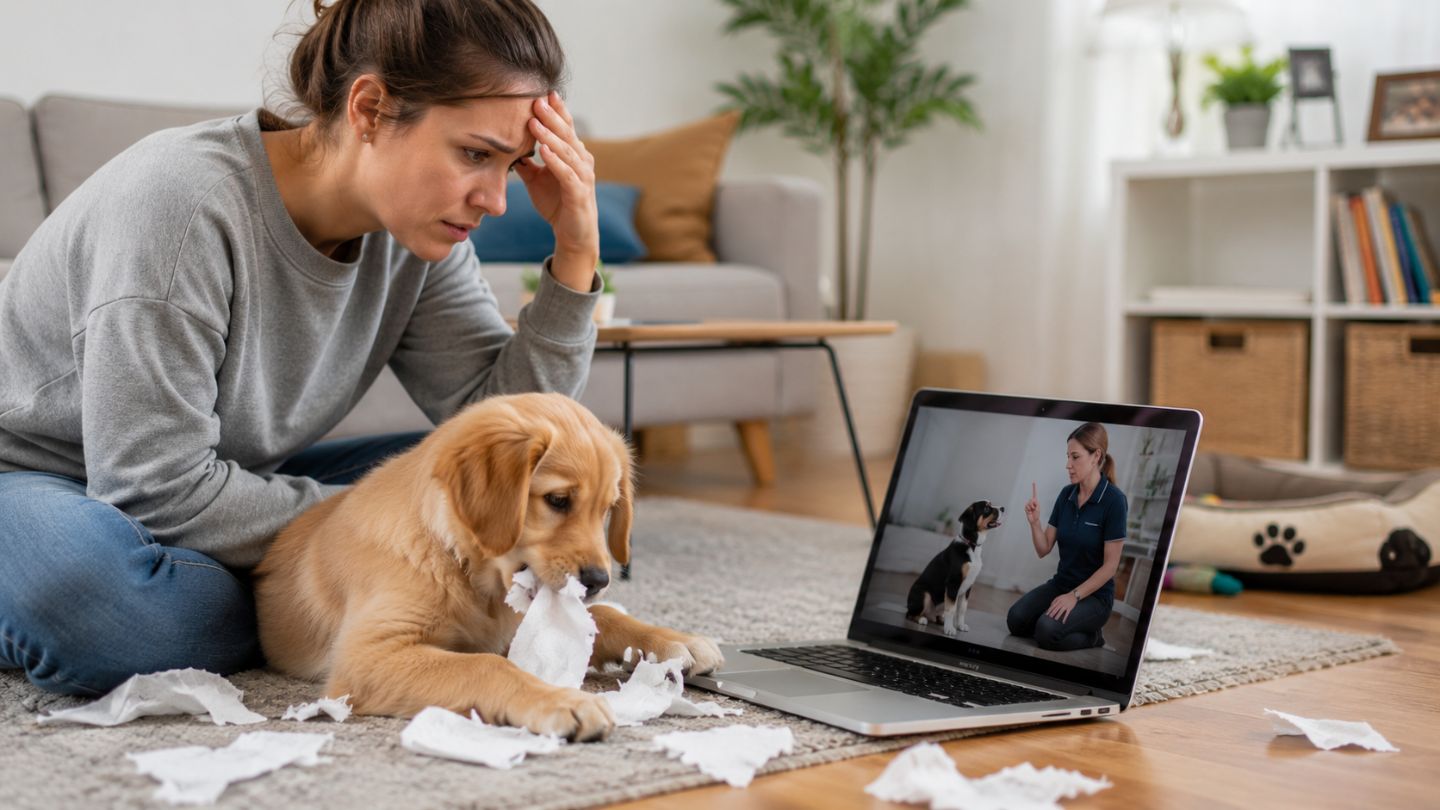
Common Mistakes Pet Owners Make in Online Puppy Training
Online puppy training has transformed how dog owners approach obedience training, offering convenience and flexibility that traditional classes can’t match. Yet many pet owners struggle to achieve results because they unknowingly repeat the same common mistakes in virtual learning environments. Understanding these pitfalls and how to avoid them can mean the difference between a well-behaved dog and months of frustrating, inconsistent training.
This blog covers the most critical errors puppy owners make during online training sessions, from environmental setup failures to unrealistic expectations, and provides actionable solutions to help both you and your pup succeed in the virtual training process.
Key Takeaways
- Lack of proper setup and environment control undermines virtual training effectiveness
- Inconsistent practice between online sessions causes dogs to forget commands and develop bad habits
- Failing to adapt techniques for virtual learning leads to poor timing and delayed reward delivery
- Expecting immediate results from online programs creates frustration and premature abandonment
- Poor technology setup prevents trainers from assessing your dog’s behavior and providing accurate feedback
Not Setting Up a Proper Training Environment
One of the most common mistakes pet owners overlook is the critical importance of the environment in online dog training. Unlike in-person classes, where a professional puppy trainer controls the space, virtual sessions place that responsibility entirely on you. Distractions at home, background noise from TV, other dogs wandering through, and family members walking by directly interfere with your puppy’s ability to focus and learn basic commands.
Dogs respond best in predictable, consistent settings. When your training space contains too many stimuli, your pup cannot form the positive associations needed for lasting behavior change.
Common environmental mistakes include:
- Training in rooms with background noise or high foot traffic
- Allowing other dogs or animals to roam freely during sessions
- Poor lighting that obscures your dog’s posture and body language from the trainer
- Camera positioned too far away or at angles that hide leash tension and weight shifts
Creating an Optimal Online Training Space
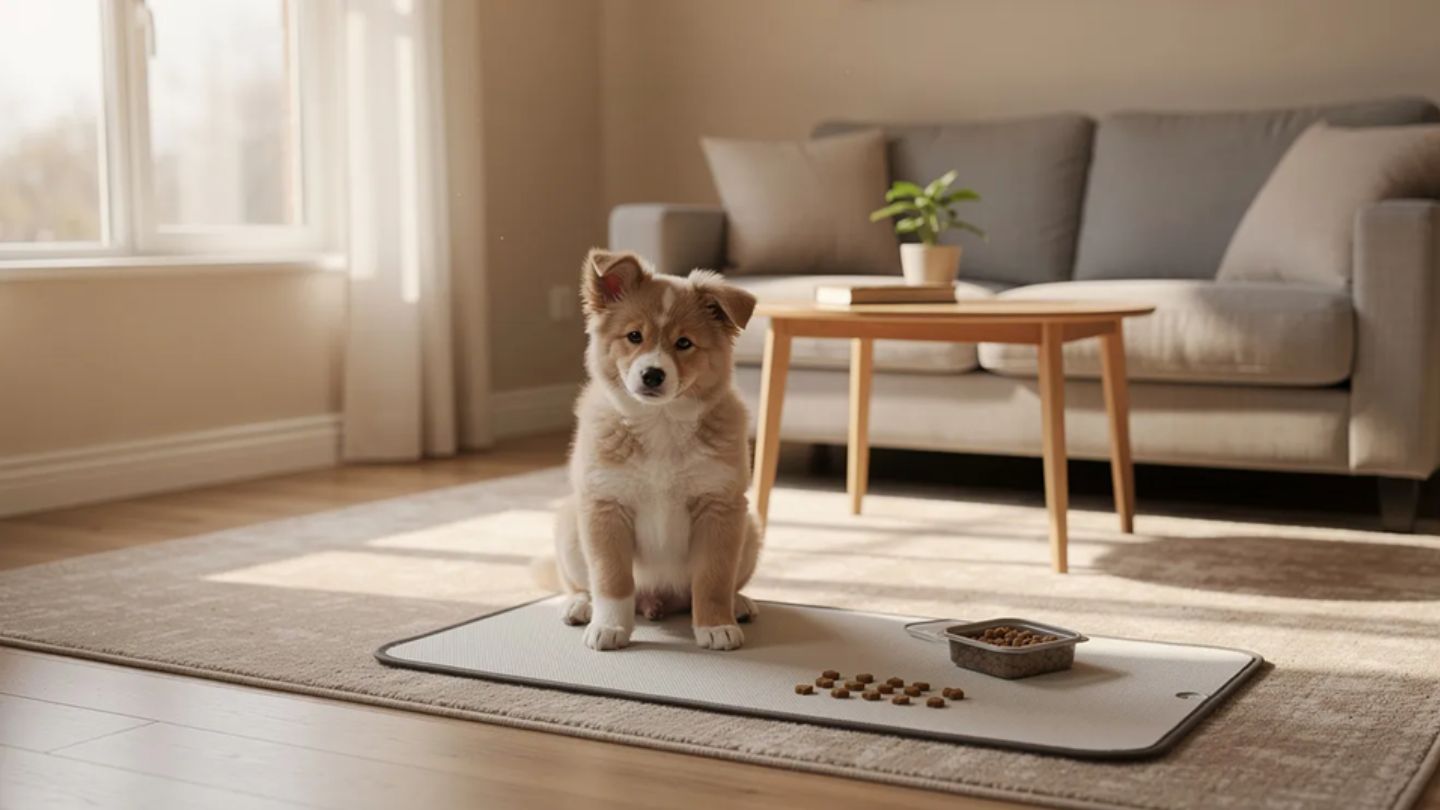
Setting up a proper training area requires intentional planning. Choose a specific place in your house or yard as your dedicated training “stage” and maintain its layout consistently throughout your puppy’s learning journey.
Steps for creating a distraction-free training area:
- Select a quiet room with minimal external noise and close windows if needed
- Remove unnecessary furniture and clutter that could distract your pup
- Sequester other dogs and pets in a separate area during training sessions
- Prepare all training tools beforehand, treat pouch, leash, clicker, mat, so you’re not scrambling mid-session
- Use a consistent, simple background so your trainer can easily notice movement differences
Lighting and camera positioning tips:
- Position lighting in front of you and your puppy to avoid backlighting and shadows
- Place your camera at your dog’s level using a tripod or stable surface to capture full body posture
- Ensure the frame shows your dog’s entire body, including ears, tail, and leash
- Test your setup before each session to confirm visibility
Inconsistent Practice Between Online Sessions
Online puppy training demands more self-discipline than in-person classes because there’s no instructor physically present to hold you accountable. Many dog owners make the mistake of treating virtual sessions as the entirety of their training, when in reality, daily routine practice between classes determines success, and tools like puppy training apps with progress tracking and personalized plans can help you stay consistent.
Learning through positive reinforcement requires repeated trials and consistent reinforcement schedules. Without frequent practice, memory decay causes a reduction in desired behavior. Dogs learn best when commands and rules remain consistent. If you allow your dog to do something one day and scold them for it the next, they will become confused, and disobedience follows.
Many new puppy owners mistakenly believe their puppy will naturally learn appropriate behaviors without guidance, leading to the development of unwanted habits. Allowing puppies to rehearse unwanted behaviors, such as jumping or barking, can reinforce these actions, making them harder to correct later on.
Actionable tips for maintaining training momentum:
- Build a schedule with multiple short sessions daily (5-10 minutes, 2-3 times per day) rather than one long weekly session
- Keep a training log recording what you practiced, successes, and setbacks to spot patterns
- Use habit stacking by tying training into existing daily routines, like before meals or walks
- Set small, measurable goals for each session, duration, distance, and distraction level, so progress remains visible
Common Consistency Mistakes to Avoid
Inconsistent training can lead to confusion and disobedience in dogs, undermining previous training efforts and making it harder for them to learn new commands. Here are specific mistakes to watch for:
- Changing verbal cues: Using “sit down” one day and “sit” the next confuses your pup
- Irregular practice times: Dogs thrive on routine; sporadic training prevents habit formation
- Varying tone of voice: Dogs respond to consistency in how commands sound
- Different handlers using different signals: All family members must use identical cues
Using inconsistent commands or cues can confuse dogs, leading to frustration for both the dog and the owner. Family members undermining training, perhaps by allowing behaviors you’re working to eliminate, creates confusion that derails online program success. Define exactly each verbal and hand cue, ensure everyone in the household follows the same protocol, and establish a structured training routine that teaches your puppy the rules and expectations of their environment.
Technology and Communication Issues
Technical problems represent a unique challenge in virtual dog training that many pet owners underestimate. Poor internet connection creates lag that disrupts timing, and timing is crucial when rewarding your dog. Rewards should be given immediately after a command is successfully carried out to ensure the dog associates the reward with the behavior. Even delays as short as half a second in operant conditioning produce significantly worse outcomes.
Camera angles present another critical issue. If only your headshot is visible, your trainer cannot assess body posture, ear position, tail movement, or weight shifts that indicate your dog’s emotional state and learning progress. When your pup moves out of frame or lighting obscures details, behavior gets misinterpreted or missed entirely.
Communication clarity suffers in virtual settings because trainers cannot physically guide you. Misunderstandings about hand placement or leash tension may persist because your instructor can’t reposition you directly. Recording training sessions can help identify mistakes in timing or body language, which is especially important without an in-person trainer present.
Solutions for optimizing technology setup:
- Test internet speed before your first session; use a wired connection where possible
- Use a high-quality camera on a tripod positioned at your dog’s level
- Ensure your treat delivery happens close to the camera view so the trainer can observe timing
- Use a clicker or consistent verbal marker to signal the precise moment of desired behavior
- Record sessions for review and share video clips with your trainer between live classes
- Communicate proactively when instructions are unclear
Expecting Immediate Results from Online Programs
One of the most common mistakes new dog owners make is expecting their dogs to learn commands immediately. Training requires time, patience, and consistent practice, yet online puppy training often suffers from unrealistic expectations due to heavily edited video tutorials or the use of pre-trained dogs that make results look instantaneous.
Virtual learning typically progresses more slowly than in-person training for several reasons. In-person sessions benefit from trainers physically modeling behaviors, adjusting your posture, and providing immediate tactile cues. In virtual settings, you must translate verbal instructions into action without the same guidance, which takes more time and practice, making thoughtfully structured online puppy classes for young puppies 8–16 weeks especially valuable.
Realistic milestones for online puppy training:
- Basic obedience (sit, stay, down) in low-distraction environments: 2-4 weeks of daily short sessions
- Generalization to more distracting environments: 6-8 weeks or longer
- Complex behaviors like reliable recall off-leash: Several months of consistent work
Training sessions should be kept short, ideally between 5 and 10 minutes, to match the attention span of puppies and enhance learning. Focusing on one command at a time during training helps prevent overwhelming your pup and promotes better understanding and retention.
Tips for staying motivated during the virtual learning process:
- Celebrate incremental progress, a 3-second stay becoming 5 seconds is a genuine achievement
- Connect with virtual training communities for accountability and support
- Use incremental goal setting rather than focusing on end results
- Remember that many owners mistakenly stop training after learning basic commands, which leads to forgotten skills and resurgence of bad habits, especially as puppies approach the adolescent stage, often considered the hardest age to train a dog.
Not Adapting Training Techniques for Virtual Format
Online training requires modified approaches compared to in-person methods, and failing to make these adaptations is a mistake many pet owners overlook. The virtual format changes everything about how you deliver rewards, receive feedback, and proof behaviors.
Using rewards for positive responses to commands creates positive associations with the cue and the desired behavior, but timing becomes more challenging without an instructor present to guide you in real-time. Using inconsistent rewards can confuse dogs, as they may not fully understand what behavior is being praised. Rewards must be delivered within 1-2 seconds of the desired behavior, and in virtual settings, you alone are responsible for that precision.
Clear, distinct body language and hand signals are more effective for communication in dog training compared to continuous verbal instructions. In virtual sessions, your trainer has limited visibility into your movements, so mastering these signals becomes essential for teaching your pup effectively.
Training sessions should be kept positive, with successful repetitions heavily rewarded at the end of each session to maintain enthusiasm in puppies. Positive reinforcement techniques should be preferred over outdated or harsh training methods that use fear or pain, which can cause more harm than good and damage the trusting relationship you’re building with your furry friend.
Tips for maximizing limited instructor visibility:
- Reposition your camera for different exercises as needed
- Send short video clips to your trainer between sessions for review
- Request annotated video feedback on your technique
- Learn to read your dog’s behavior yourself, ear position, tail carriage, eye gaze
- Have high-value treats, a clicker, a leash, and a training mat prepared before each session begins
- Practice in quiet settings first; it’s important to avoid allowing a puppy to perform commands in highly distracting environments without first mastering them in calmer spaces
Creating Better Results Through Consistent Puppy Training

Successful puppy training requires patience, consistency, and the right guidance to avoid common mistakes that can slow progress and create unwanted behaviors. Understanding how to properly communicate with your puppy, reinforce positive habits, and stay consistent with training methods helps build confidence, obedience, and a stronger bond that supports long-term behavioral success.
Custom Canine Unlimited offers professional online puppy training programs designed to help pet owners build better behavior and obedience skills from home. We also provide online k9 courses, training support in Buford and Sarasota, and dog boarding in Columbus, GA, to meet a variety of training and care needs. Let us help you create a more positive and structured training experience that leads to lasting results for your puppy.
Frequently Asked Questions
What equipment do I need for effective online puppy training?
Essential equipment includes a quality camera or smartphone on a stable tripod, a reliable internet connection, a treat pouch with high-value treats, a clicker or consistent marker word, an appropriate leash and collar or harness, and a training mat. Position your camera at your dog’s level with good lighting to ensure your trainer can assess your pup’s body language and your technique.
How can I get better feedback from my online trainer?
Recording your training sessions and submitting video clips between live classes allows your trainer to provide specific, actionable feedback. Ask for annotated video responses, request that your trainer watch live exercises and offer real-time corrections, and share multiple camera angles when possible. Communicate clearly about what aspects of the training process feel challenging.
Is online puppy training as effective as in-person training?
For basic obedience and many behavior issues, online training can be highly effective and offers the advantage of training in your dog’s natural environment, where unwanted behavior actually occurs. However, gaps remain in socialization opportunities with other dogs and practice under real-world distractions. Under-socialized dogs may struggle to adjust to new people and places, while well-socialized dogs tend to be more confident and adaptable. A hybrid approach combining virtual coaching with occasional in-person sessions often produces the best results.
What should I do if my puppy gets distracted during virtual sessions?
Reduce distractions by moving to a quieter room, closing doors and windows, removing other pets, and preparing treats in advance. Keep sessions very short; puppies lose interest quickly, and pause if needed. Reward attention first, even a brief glance, then gradually build mental stimulation through structured play and incrementally more challenging distraction levels. Baby gates can help manage your training space effectively.
How long does it typically take to see results with online training programs?
Expect basic commands like sit in low-distraction settings within 2-4 weeks of consistent daily practice. Generalization to new environments and reliable behavior under distractions typically takes 6-8 weeks or longer. Complex behaviors such as potty training reliability, crate training acceptance, or leash walking with low anxiety may take several months, which is why following a clear, structured 10-10-10 potty training routine can make housebreaking more predictable. Progress depends heavily on consistency, technique, and your puppy’s individual energy level and temperament.
Share this article

Written by : AJ Vargas
AJ Vargas is a highly skilled Canine Trainer at Custom Canine Unlimited, bringing extensive hands-on experience in law enforcement, working dogs, and specialized K9 operations. With a deep commitment to public safety and canine performance optimization, AJ has trained and deployed working dogs in high-stakes environments, supporting law enforcement agencies and security teams across the country. His expertise spans obedience, detection, patrol work, and real-world deployment readiness, ensuring both dogs and handlers achieve operational excellence. At Custom Canine Unlimited, AJ continues to advance canine training standards, helping shape top-tier K9 teams that deliver measurable results in the field.
Follow us
A quick overview of the topics covered in this article.
- Key Takeaways
- Not Setting Up a Proper Training Environment
- Creating an Optimal Online Training Space
- Inconsistent Practice Between Online Sessions
- Common Consistency Mistakes to Avoid
- Technology and Communication Issues
- Expecting Immediate Results from Online Programs
- Not Adapting Training Techniques for Virtual Format
- Creating Better Results Through Consistent Puppy Training
- Frequently Asked Questions
- What equipment do I need for effective online puppy training?
- How can I get better feedback from my online trainer?
- Is online puppy training as effective as in-person training?
- What should I do if my puppy gets distracted during virtual sessions?
- How long does it typically take to see results with online training programs?